

Missing Tooth Fix: Why Dental Implants in Bandra Mumbai Are the Best Option

Reviewed by Dr. Sailee Kalyankar
Last updated: July 03, 2026
Table of Contents
Quick Treatment Guide for Dental Implants
Q: Why are dental implants in Bandra Mumbai considered the gold standard?
A: Dental implants are the only missing tooth solution that replaces the root — not just the visible tooth. This prevents bone loss, maintains facial structure, and functions identically to a natural tooth for decades.
Q: Is titanium implant surgery painful?
A: No. The implant surgery is performed under local anaesthesia — the area is completely numb. Most patients report the procedure feels like pressure, not pain, and describe post-surgery discomfort as milder than expected.
Q: How long does osseointegration take after dental implant placement?
A: Osseointegration — the process of the titanium post fusing with jawbone — takes 6 to 12 weeks. The final crown is placed once this fusion is confirmed, completing the permanent tooth replacement.
Q: How long do dental implants last?
A: The titanium implant post can last a lifetime with proper care. The ceramic crown placed on top typically lasts 15–20 years before replacement is considered.
Q: Are dental implants better than dentures?
A: Yes, in almost all cases. Implants are fixed, prevent bone loss, require no adhesives, and function like natural teeth. Dentures are removable, less stable, and do not stop jawbone deterioration.
Dental implants in Bandra Mumbai are now the most requested solution for missing teeth — and the more people understand what they actually are, compared to the alternatives, the clearer the reason becomes.
A missing tooth is rarely just a cosmetic problem. It is a structural one. The moment a tooth is lost, the jawbone beneath it begins to change. The teeth on either side begin to tilt. The bite shifts. The face shape, over years, begins to follow. What starts as a gap in the smile becomes, if left unaddressed, a cascade of changes that get more expensive and more complex to correct with each passing year.
This guide gives you a clear, honest picture of why dental implants are considered the gold standard for missing teeth, what the surgical process actually feels like, and how long the entire journey from placement to final crown really takes — without the exaggeration in either direction.
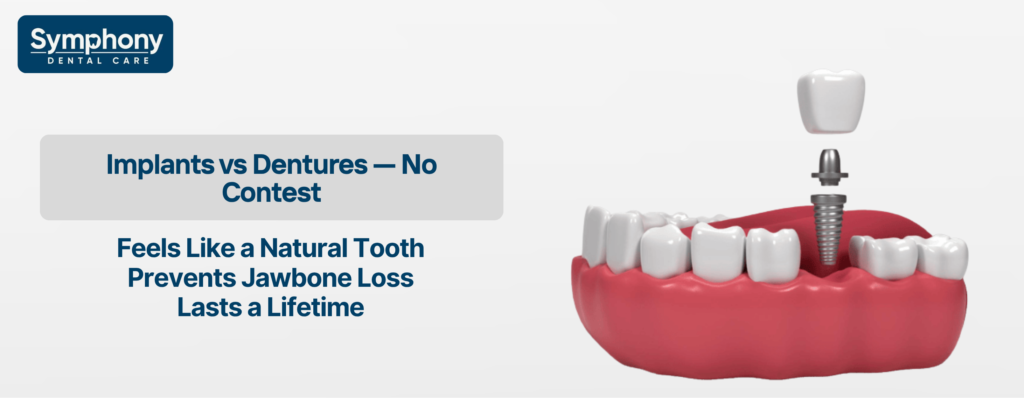
Why Do Oral Surgeons Consider Dental Implants in Bandra Mumbai the Gold Standard for Missing Teeth?
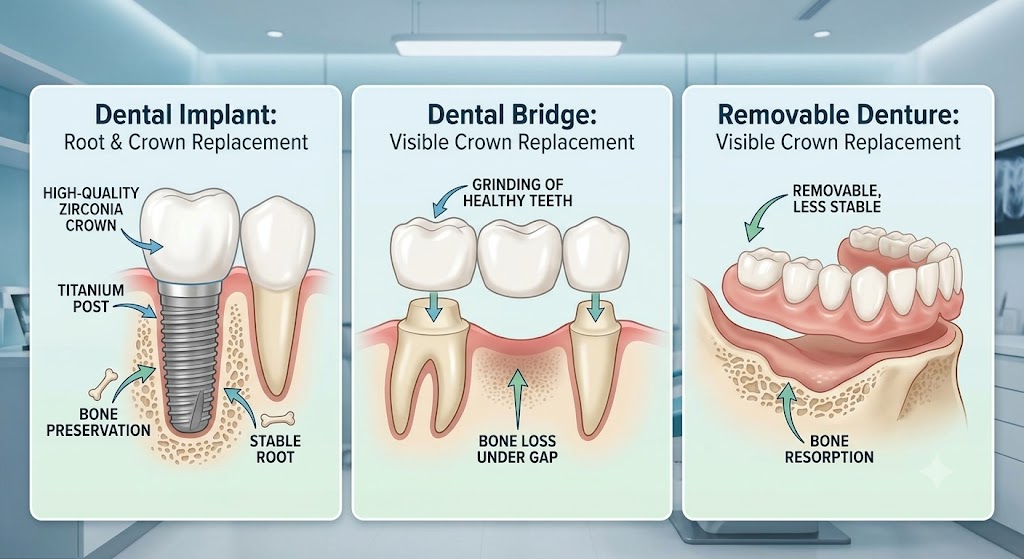
Dental implants in Bandra Mumbai are the gold standard because they are the only tooth replacement option that replaces both parts of a missing tooth — the visible crown above the gum and the root below it. Every other option replaces only the crown, leaving the underlying bone without stimulation.
This distinction — replacing the root — is what separates implants from dentures and bridges fundamentally, not just aesthetically.
What a Dental Implant Actually Is
A dental implant is a small titanium post — typically 3 to 5 millimetres in diameter and 8 to 16 millimetres long — that is surgically placed into the jawbone where the missing tooth root once sat. Over 6 to 12 weeks, the bone grows around and bonds to this titanium post in a process called osseointegration. Once fully integrated, the post functions as an artificial root — stable, permanent, and capable of bearing full biting force.
A custom-made ceramic crown is then attached to the top of this integrated post, completing the tooth replacement. The result looks, functions, and is cleaned exactly like a natural tooth.
The Problem With Dentures — What Nobody Tells You
Dentures address the visible gap. They do not address the bone beneath it. Without the stimulation of a tooth root, the jawbone in the area of a missing tooth gradually resorbs — shrinks in volume and density over months and years. This is why long-term denture wearers often develop a characteristic sunken appearance around the mouth — the bone structure supporting the facial tissue has diminished.
Removable dentures also move. The adhesives that hold them in place are never as reliable as the natural suction and muscle control suggests in advertisements. Foods that require firm biting force — apples, corn, many meats — become difficult or impossible with confidence. The social anxiety of a denture shifting during a meal or conversation is real, and it is commonly reported by patients who choose dentures initially and later seek implants.
A fixed dental bridge — the other common alternative — covers the gap by placing crowns on the two teeth flanking the missing tooth, with a false tooth suspended between them. This avoids bone loss to some degree but requires grinding down two perfectly healthy adjacent teeth to support the bridge. Destroying healthy tooth structure to replace a missing one is clinically suboptimal, and the bridge itself needs replacement after 10–15 years.
The implant avoids every one of these compromises. It is the only solution that is permanent, prevents bone loss, preserves adjacent teeth, and functions identically to the tooth that was lost.
Is the Surgical Placement of a Titanium Dental Implant Painful?
No — implant surgery is performed under local anaesthesia that numbs the area completely. During the procedure itself, patients feel pressure and vibration but not pain. Post-surgical discomfort in the days following is real but consistently milder than most patients anticipate.
The fear of implant surgery is almost universal among patients who are considering it — and almost universally revised once the procedure is completed. The word “surgery” carries associations that the implant procedure, for most straightforward cases, does not deserve.
During the Procedure
After the anaesthetic has been administered and the area is confirmed as fully numb, the implant placement itself typically takes 45 to 60 minutes per implant. The dentist makes a small incision in the gum to access the bone, uses a series of precisely calibrated drills to create a channel exactly matching the implant dimensions, and places the titanium post into position. The gum is then sutured closed over or around the implant, depending on the technique used.
Throughout this process, patients feel pressure and the sensation of the drill — but not pain. The absence of pain, when most people have spent weeks dreading the appointment, is frequently described as the most surprising part of the entire implant experience.
After the Procedure — Managing Recovery Honestly
The local anaesthetic wears off 3 to 5 hours after the procedure, at which point mild to moderate soreness begins. This is managed with standard over-the-counter pain relief — paracetamol or ibuprofen — and typically resolves significantly within 48 to 72 hours. Some swelling and minor bruising is normal and resolves within a week.
Soft foods are recommended for the first week — nothing that requires direct biting on the implant site. Normal eating returns gradually as healing progresses over the following 2 to 3 weeks.
The honest comparison most patients make after the fact: “It was less uncomfortable than my tooth extraction.” This is, clinically, accurate — implant placement into prepared bone is a controlled procedure, while extraction involves the mechanical removal of a tooth with attached ligaments and bone. Recovery from implant surgery is typically smoother.
If your missing tooth resulted from an infection that required emergency extraction, read Dental Emergency in Bandra? 5 Signs You Need an Emergency Dentist in Bandra West Right Now to understand how emergency treatment and planned implant placement connect.
What Is the Total Healing and Osseointegration Timeline for Permanent Implants?
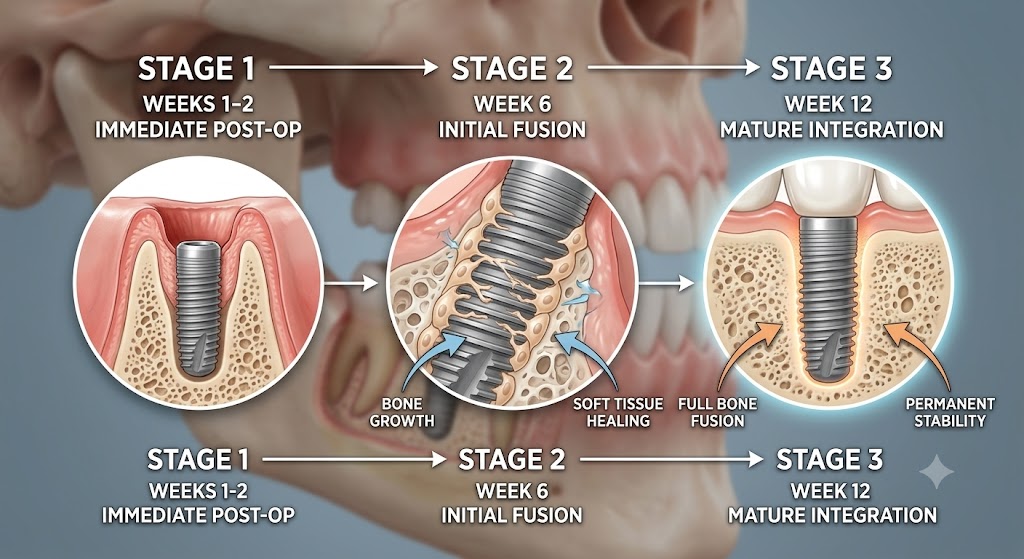
The total timeline from implant surgery to final crown placement is typically 3 to 6 months — the majority of this time is passive healing, during which the titanium post fuses with the jawbone. Active treatment time is limited to 2 to 3 clinic appointments.
This is where many patients’ expectations need gentle adjustment. Dental implants are not a same-day procedure. The timeline is determined entirely by biology — how long your bone takes to integrate with the titanium post — and no technology or technique meaningfully accelerates this process without compromising the outcome.
Stage 1 — Pre-Surgical Assessment (1–2 Weeks Before Placement)
Before implant surgery, a detailed assessment is conducted — including digital X-rays and, where needed, a CBCT scan (3D imaging of the jawbone) to assess bone density, height, and the precise position of anatomical structures like nerves and sinuses. This assessment determines whether sufficient bone is present for implant placement or whether a bone graft is required first.
Stage 2 — Implant Surgery (Day 1)
The titanium post is placed under local anaesthesia in a single appointment lasting 45 to 90 minutes, depending on the number of implants being placed. A healing cap or temporary crown may be placed at this stage, ensuring you leave the clinic without a visible gap.
Stage 3 — Osseointegration (Weeks 1 to 12)
This is the waiting period — and it is doing more work than it appears. The jawbone is growing into the microscopic surface texture of the titanium post, creating a biological bond that will ultimately be stronger than the original tooth root attachment. This process takes 6 to 12 weeks depending on the patient’s bone density, overall health, and whether a bone graft was required.
During this period, routine oral hygiene continues normally around the implant site. Avoid smoking and alcohol, which interfere with healing. Follow-up appointments are scheduled to monitor healing progress.
Stage 4 — Crown Placement (Week 10–16)
Once osseointegration is confirmed — either by clinical assessment or a follow-up X-ray showing full bone integration — an impression or digital scan of the healed implant is taken. A custom ceramic crown, matched precisely to the shade and shape of your adjacent natural teeth, is fabricated and attached to the implant abutment. This final appointment takes 30 to 45 minutes.
From this point, your implant is complete — and indistinguishable from a natural tooth to anyone who does not already know it is there.
Why Choose Symphony Dental Care for Dental Implants in Bandra Mumbai?
Dr. Sailee Kalyankar — BDS, MDS | Conservative Dentist & Implant Specialist
Dr. Sailee Kalyankar approaches implant treatment with the same conservative, evidence-based philosophy she applies to every procedure — assessing whether implant placement is genuinely appropriate for each patient’s bone structure and health profile before recommending it, and being transparent about timelines, costs, and realistic outcomes from the first conversation.
Her conservative background means adjacent healthy teeth are never compromised for convenience. Where a single implant is the right solution, a bridge that requires grinding down neighbouring teeth will not be suggested instead. Where extraction can be avoided entirely — through root canal treatment, for instance — that option is explored first.
For patients who are anxious about the surgical component, Dr. Sailee’s approach to managing procedural anxiety — topical numbing before any injection, slow anaesthesia delivery, clear narration throughout the procedure — is applied to implant surgery exactly as it is to every other treatment at Symphony Dental Care.
What Every Implant Patient at Symphony Dental Care Receives
- CBCT / 3D imaging where required — precise pre-surgical bone assessment
- Digital impressions for crown fabrication — no uncomfortable putty trays
- High-grade titanium implants — biocompatible, durable, clinically proven
- Premium zirconia crowns — natural appearance, matched precisely to adjacent teeth
- Full timeline transparency — every stage explained before treatment begins
- International sterilisation standards — autoclave, single-use disposables, surface disinfection at every visit
Planning multiple restorations alongside your implant? Read our guide on Best Dentist in Bandra West at Symphony Dental Care to understand the full range of restorative and cosmetic treatments available.
Price Breakdown: Dental Implants Cost in Bandra Mumbai
| Treatment | Approx. Cost (INR) | Notes |
|---|---|---|
| Implant Consultation & X-Ray | ₹500 – ₹1,500 | Includes clinical assessment |
| CBCT 3D Bone Scan (if required) | ₹2,500 – ₹5,000 | Required for complex cases |
| Single Titanium Implant Post | ₹25,000 – ₹45,000 | Placement surgery included |
| Bone Graft (if required) | ₹15,000 – ₹35,000 | When bone density is insufficient |
| Zirconia Crown (on implant) | ₹12,000 – ₹20,000 | Final tooth restoration |
| Full Implant Package (post + crown) | ₹35,000 – ₹80,000 | All-inclusive single tooth |
| Implant-Supported Denture (full arch) | ₹1,50,000 – ₹4,00,000 | Multiple implants supporting fixed arch |
All costs are confirmed in writing before treatment begins. EMI options are available for implant treatment packages.
Frequently Asked Questions (FAQs)
Most healthy adults with sufficient jawbone density are suitable candidates. Conditions like uncontrolled diabetes or active gum disease need management before implant placement. A consultation and bone scan confirm eligibility.
Jawbone begins to resorb, adjacent teeth shift toward the gap, and bite alignment changes over time — all of which become increasingly costly to correct the longer tooth replacement is delayed.
The titanium post, once integrated, can last a lifetime with proper care. The ceramic crown typically lasts 15–20 years before replacement is considered.
Smoking significantly reduces implant success rates by interfering with healing and osseointegration. Stopping smoking before and during the healing period substantially improves outcomes. Dr. Sailee Kalyankar will discuss this honestly at consultation.
There is no upper age limit. For younger patients, implants are recommended only after jaw growth is complete — typically after 18. Adults of any age can undergo implant treatment.
No. A bone graft is only required when the jawbone has resorbed sufficiently that it cannot support an implant of adequate size. Whether a graft is needed is determined by the pre-surgical CBCT scan.
Implant failure is uncommon — global success rates are approximately 95–98%. Risk factors include smoking, uncontrolled diabetes, poor oral hygiene, and insufficient bone density. All are assessed and discussed before treatment.
A standard implant replaces a single missing tooth. Implant-supported dentures use multiple implants to anchor a full arch of teeth permanently — combining the stability of implants with full-arch restoration.
Brush twice daily, floss carefully around the implant crown, and maintain six-monthly check-ups. Implants are cared for identically to natural teeth — no special cleaning routine is required.
A Missing Tooth Is Not Just a Gap — It Is a Decision That Gets Harder to Reverse
Every month a missing tooth goes unreplaced, the bone beneath it continues to change. The longer the gap remains, the more complex — and more expensive — the eventual solution becomes. Dental implants in Bandra Mumbai exist to interrupt that process: to replace the root, preserve the bone, and restore the tooth permanently.
If you have been living with a gap or making do with a removable denture that has never felt quite right, a consultation at Symphony Dental Care is the clearest next step. No pressure, no rushed decisions — just an honest clinical assessment of your options and a realistic picture of what the implant journey would look like for your specific case.
You do not have to live with the gap. You just have to make one call.
Symphony Dental Care | Bandra West & Khar West, Mumbai Call: 7678045993 Open 7 Days | 7:45 AM – 10:00 PM