

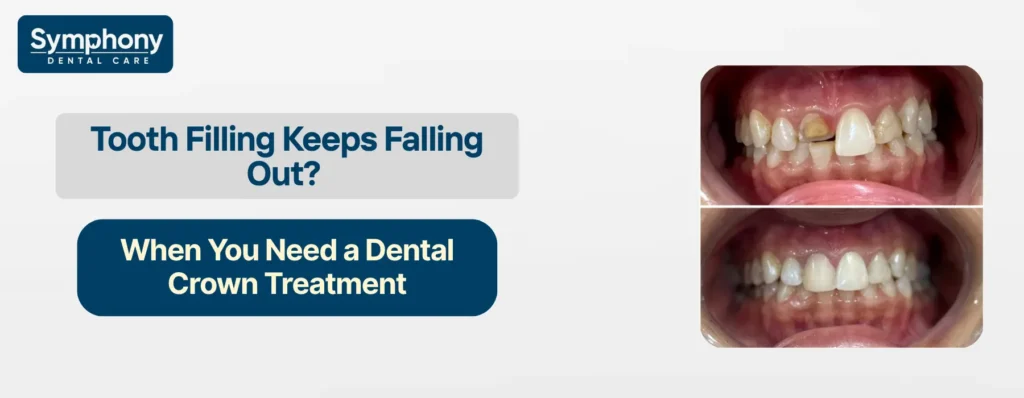
Tooth Filling Keeps Falling Out? When You May Need a Dental Crown Instead

Reviewed by Dr. Sailee Kalyankar
Last updated: August 5, 2026
Table of Contents
Introduction
You had a cavity filled, everything seemed fine, and then one day you notice something hard in your food. You check your tooth and realise that the filling has fallen out again.
If this has happened more than once, you may be wondering:
“Why does my dental filling keep falling out? Do I need a crown instead?”
A filling can fail for several reasons. The tooth may have extensive decay, the restoration may be large, the remaining tooth structure may be weak, or the tooth may have developed a crack. In some situations, replacing the filling may be appropriate. In others, repeatedly placing another filling may not provide the structural support the tooth needs.
A dental crown is different from a filling. Instead of simply filling a cavity or repairing a limited area, a crown covers and protects the tooth more extensively. Crowns are commonly used when a tooth has been significantly damaged, broken, or weakened.
At Symphony Dental Care, Bandra West, Dr. Sailee Kalyankar and the dental team evaluate the remaining tooth structure, the condition of the existing restoration, symptoms, and overall oral health before recommending a replacement filling, crown, root canal treatment, or another appropriate option.
Why Does a Dental Filling Keep Falling Out?
A filling is designed to restore tooth structure lost through decay or damage, but it does not make every tooth structurally strong enough for a large or repeated restoration.
Several factors can contribute to a filling becoming loose, cracked, or dislodged.
1. The Filling Is Very Large
If a large portion of the tooth was damaged by decay, the filling may occupy a substantial part of the tooth. Over time, the remaining natural tooth structure may not provide enough support for another large filling.
This is particularly important for back teeth, which experience significant chewing forces.
2. The Tooth Has Become Weakened
A tooth with extensive decay or previous dental work may have less healthy structure remaining. In these situations, repeatedly replacing the filling may not address the underlying structural problem.
Your dentist may instead recommend a restoration that covers and protects more of the tooth.
3. There Is a Crack in the Tooth
Sometimes a filling falls out because the tooth underneath it has cracked.
A cracked tooth may cause:
- Pain when biting
- Sensitivity to cold
- Intermittent toothache
- Pain when releasing a bite
- A visible fracture or broken cusp
The American Association of Endodontists (AAE) notes that a fractured cusp can occur around a filling and may sometimes be treated with a new filling or crown. For a deeper crack involving the pulp, root canal treatment followed by a crown may be necessary.
American Association of Endodontists – Cracked Teeth
4. Tooth Decay Has Developed Around the Filling
A filling does not make a tooth immune to future decay. If bacteria and plaque accumulate around the edges of a restoration, new decay can develop.
This can weaken the tooth and compromise the seal around the filling. The ADA’s evidence-based restorative guidance supports conservative management of tooth decay while selecting an appropriate restorative approach based on the clinical situation.
5. You Grind or Clench Your Teeth
Teeth grinding and clenching can place significant forces on teeth and dental restorations. If you regularly grind your teeth, a filling may be subjected to forces beyond what it can tolerate, particularly when the tooth is already weakened.
Signs of possible grinding include:
- Worn tooth surfaces
- Morning jaw soreness
- Headaches
- Flattened tooth edges
- Repeatedly damaged fillings
- Tooth sensitivity
If grinding is suspected, your dentist may recommend measures such as a custom night guard along with appropriate restorative treatment.
6. The Filling Has Simply Become Damaged
Dental restorations are not indestructible.
A filling can:
- Crack
- Wear down
- Chip
- Become loose
- Develop a gap
- Fall out completely
The appropriate solution depends on why it failed and how much healthy tooth structure remains.
Is a Filling Falling Out a Dental Emergency?
A lost filling is not always a dental emergency, but it should not be ignored.
The urgency depends on your symptoms and the condition of the tooth.
Usually Requires Prompt Dental Assessment
- The filling has completely fallen out.
- The tooth has a sharp edge.
- You have sensitivity to hot or cold.
- Food keeps getting trapped.
- The tooth hurts when you bite.
- The tooth appears cracked or broken.
Seek More Urgent Care If You Have
- Severe or worsening tooth pain
- Facial or gum swelling
- Fever associated with dental symptoms
- Pus or a bad taste from the tooth
- Significant tooth fracture
- Difficulty swallowing or breathing
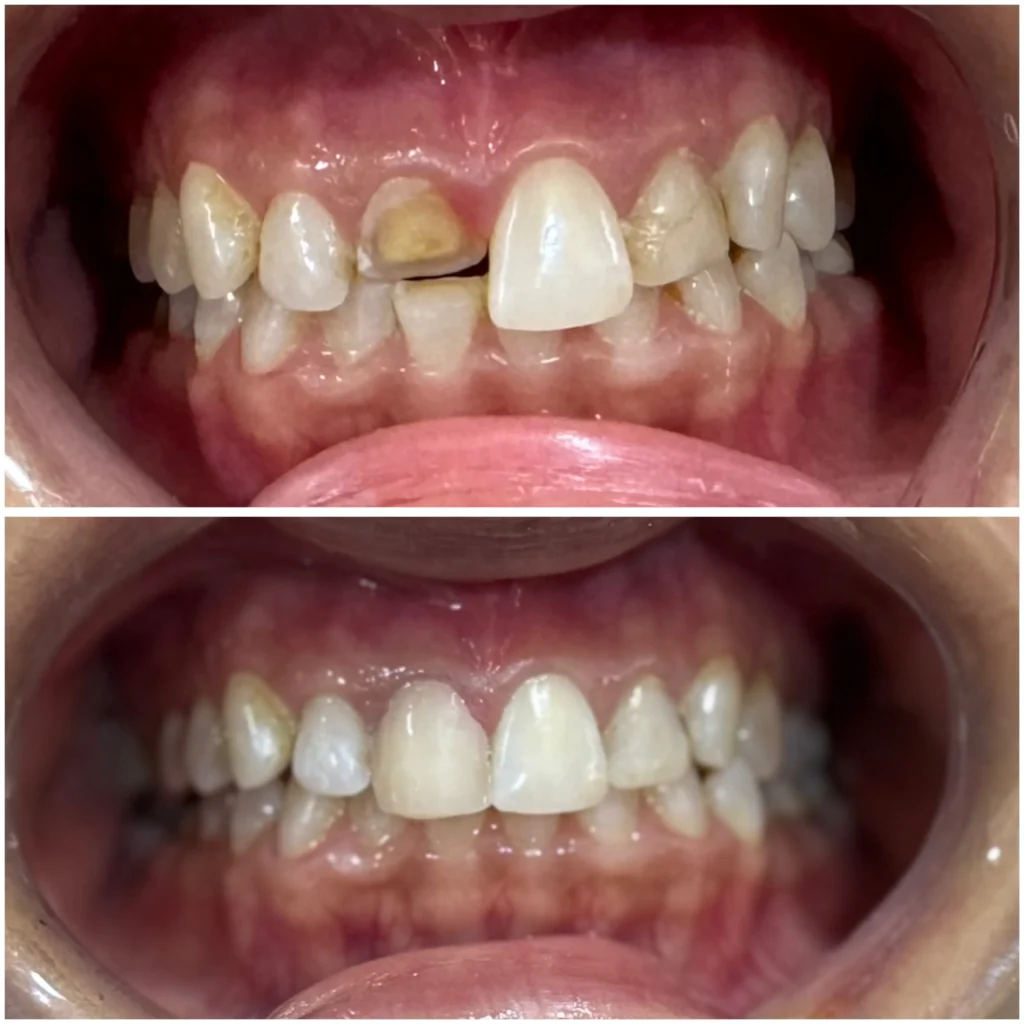
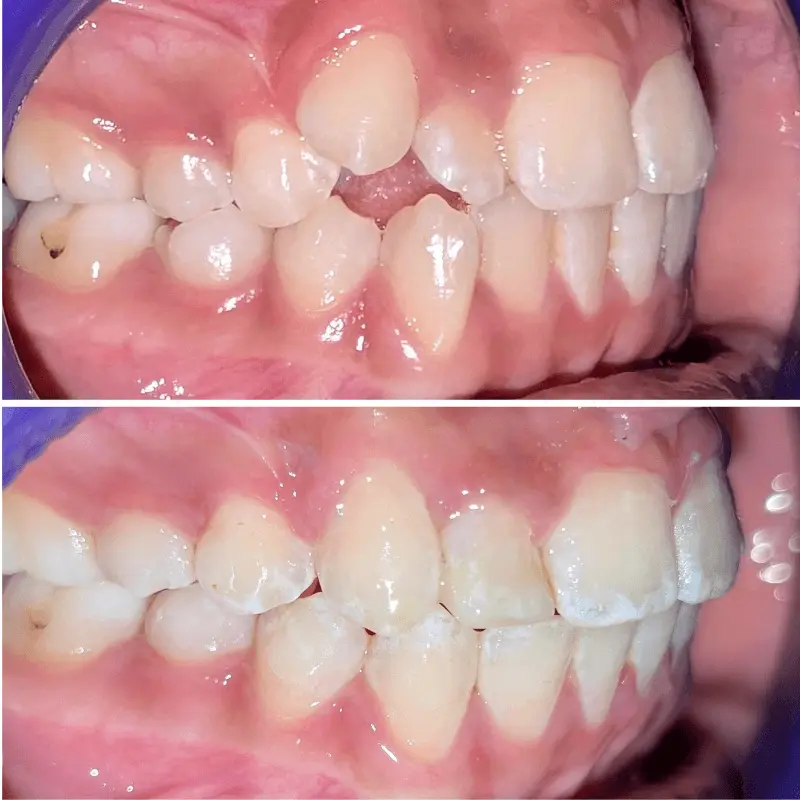
What Should You Do If Your Filling Falls Out?
Until you can see your dentist:
- Keep the area clean.
- Brush gently around the affected tooth.
- Rinse your mouth after eating if food becomes trapped.
- Avoid chewing hard foods on that side.
- Avoid very hot or cold foods if the tooth is sensitive.
- Save the filling if you have it and take it to your dentist.
- Arrange a dental appointment for assessment.
Do not try to permanently glue the filling back into the tooth yourself.
A dentist needs to determine why the filling came out before deciding whether it should simply be replaced or whether the tooth requires a different restoration.
Can the Filling Simply Be Replaced?
Sometimes, yes.
A new filling may be appropriate when:
- The remaining tooth structure is healthy.
- The cavity is relatively small or moderate.
- There is no significant crack.
- The tooth has adequate support.
- The pulp is healthy.
- The previous filling failed because of a correctable issue.
However, if the tooth has become structurally compromised, placing another large filling may not be the most appropriate long-term solution. This is where a dental crown may be considered.
When May You Need a Dental Crown?
A crown may be recommended when a tooth requires more extensive protection than a filling can provide.
Common situations include:
Large Existing Filling
If most of the tooth’s chewing surface has already been replaced by a filling, there may not be enough natural structure left to support another large restoration.
Repeatedly Failing Fillings
If the same filling repeatedly breaks or falls out, your dentist may investigate whether the tooth needs a more comprehensive restoration.
Repeated failure does not automatically mean a crown is necessary, but it is a reason to reassess the tooth rather than repeatedly replacing the restoration without identifying the cause.
Cracked or Fractured Tooth
A crown can provide coverage and protection for certain cracked or fractured teeth.
The AAE notes that treatment for a cracked tooth depends on the type, location, and extent of the crack. When the crack has reached the pulp, root canal treatment followed by a crown may be required; cracks extending below the gum line may make the tooth unrestorable.
Root Canal-Treated Tooth
A tooth that has undergone root canal treatment may require a definitive restoration to protect the remaining structure.
The AAE explains that after root canal treatment, the tooth is restored with a crown or filling depending on the clinical situation.
Filling vs Dental Crown: What's the Difference?
| Feature | Dental Filling | Dental Crown |
|---|---|---|
| Main Purpose | Repairs a cavity or limited tooth damage | Covers and protects a weakened or extensively damaged tooth |
| Coverage | Usually limited to the damaged area | Covers most or all of the visible tooth |
| Tooth Structure Required | Suitable when enough healthy structure remains | Often considered when substantial structure is lost |
| Common Uses | Small to moderate cavities | Large restorations, broken or weakened teeth |
| Procedure | Usually less extensive | More extensive |
| Laboratory Work | Usually not required | Often custom-made |
| Protection | Localised restoration | Greater structural coverage |
The choice should be based on the condition of the tooth rather than simply selecting the more expensive option.
Did You Know? The chances of successfully saving a knocked-out permanent tooth are generally highest when treatment begins within the first hour after the injury.
Dental Crown Procedure
If your dentist determines that a crown is the appropriate restoration, treatment is usually completed in stages.
Step 1: Tooth Preparation
The damaged or weakened portions of the tooth are removed, and the tooth is shaped so that the crown can fit securely.
The amount of preparation depends on the type of crown and the amount of healthy tooth structure available.
Step 2: Build-Up, If Required
If significant tooth structure has been lost, a core build-up may be required before the crown is placed. A build-up helps provide a suitable foundation for the final restoration when there is insufficient remaining tooth structure.
The ADA describes a crown build-up as rebuilding the anatomical crown when additional tooth strength and retention are needed for a restorative crown.
Step 3: Digital Scan or Impression
Your dentist may take a digital intraoral scan or traditional impression of the prepared tooth. This information is used to create a crown that fits the prepared tooth and works with your bite.
Step 4: Temporary Crown
If the permanent crown is being fabricated in a dental laboratory, a temporary crown may be placed while you wait.
The NHS notes that laboratory fabrication can mean patients receive a temporary crown until the permanent crown is ready.
Step 5: Permanent Crown Placement
Once the final crown is ready, the dentist checks:
- Fit
- Bite
- Shape
- Contact with neighbouring teeth
- Appearance
- Comfort
Timelines are approximate and vary based on individual treatment plans and clinical needs.
Temporary Crown vs Permanent Crown
| Feature | Temporary Crown | Permanent Crown |
|---|---|---|
| Purpose | Protects the prepared tooth temporarily | Definitive restoration |
| Duration | Short-term | Long-term |
| Material | Temporary restorative material | Ceramic, zirconia, metal, or other appropriate material |
| Final Fit | Temporary | Custom-fitted |
| Appearance | Usually functional/aesthetic but temporary | Designed for final appearance and function |
According to The American Association of Endodontists emphasizes preserving natural teeth whenever possible and recognizes root canal treatment as an established way to save teeth affected by pulpal or periapical disease.
Reference:
https://www.aacd.com/
How Much Does a Dental Crown Cost?
The cost of a dental crown varies between patients and clinics. There is no single price that applies to every crown.
Factors that may influence the overall cost include:
- Crown material
- Tooth location
- Amount of remaining tooth structure
- Need for a core build-up
- Need for root canal treatment
- Diagnostic imaging
- Laboratory charges
- Complexity of the case
- Dentist’s expertise
- Number of teeth being treated
Therefore, a dental crown should not be evaluated based on the crown price alone. A patient who needs a root canal, build-up, temporary crown, and permanent crown will have a different overall treatment plan from someone who only needs a crown over an otherwise healthy tooth.
Filling vs Crown: Which Is More Cost-Effective?
It can be tempting to replace a failed filling simply because it appears less expensive initially.
However, the cheapest immediate option isn’t necessarily the most appropriate long-term restoration.
| Consideration | Another Filling | Dental Crown |
|---|---|---|
| Initial treatment | Usually simpler | More extensive |
| Suitable for | Limited/moderate damage | Greater structural damage |
| Tooth coverage | Localised | Extensive |
| Structural protection | Limited | Greater |
| May require laboratory fabrication | Usually no | Often yes |
| Best choice | When sufficient tooth structure remains | When greater protection is clinically needed |
The decision should be based on what the tooth needs, not simply the initial treatment fee.
Expert Insights
According to Dr. Sailee Kalyankar, Cosmetic & Restorative Dentist at Symphony Dental Care, Bandra West, a repeatedly failing filling should prompt a closer examination of the tooth rather than an automatic decision to place another filling.

Dr. Sailee Kalyankar
BDS, MDS | Conservative Dentist and Microscopic Endodontist. Khar West | Bandra West.
Registration Number A- 35825
Why Patients Choose Symphony Dental Care
When a filling repeatedly falls out, having access to a dental team nearby can make it easier to arrange an examination before the tooth develops further problems.
For patients in Bandra West and surrounding areas, continuity of care can be particularly useful when treatment involves more than one stage, such as:
Examination → Treatment planning → Tooth preparation → Temporary restoration → Permanent crown → Follow-up
At Symphony Dental Care, Bandra West, Dr. Sailee Kalyankar and the clinical team can assess the condition of a repeatedly failing restoration and discuss whether a new filling, dental crown, root canal treatment, or another approach is appropriate.
The focus should be on understanding why the filling failed and what treatment is most suitable for the tooth, rather than automatically choosing the most extensive or expensive option.
Frequently Asked Questions (FAQs)
A filling may repeatedly fall out because of extensive tooth damage, a large restoration, new decay around the filling, a crack in the tooth, heavy biting forces, teeth grinding, or insufficient remaining tooth structure.
There is no fixed number of times a filling can safely be replaced. Each replacement may require removal of additional damaged or compromised tooth structure.
Not necessarily. A replacement filling may be suitable if enough healthy tooth structure remains and the tooth is otherwise structurally sound. A crown may be considered when the tooth is significantly weakened, extensively restored, cracked, or requires greater protection.
Neither is universally “better.” A filling is generally more conservative and suitable for appropriate cavities or limited damage, while a crown provides more extensive coverage for a weakened or significantly damaged tooth.
It depends on the type and extent of the crack. Some minor fractures or fractured cusps may be treated with a restoration, while certain cracked teeth may require a crown.
Repeatedly replacing a failed filling without addressing why it failed may not solve the underlying problem. Your dentist may need to assess the remaining tooth structure, decay, cracks, bite forces, and pulp condition to determine whether a different restoration would provide better protection.
A crown can provide long-term service when appropriately planned, placed, and maintained, but its lifespan varies between patients. Oral hygiene, bite forces, teeth grinding, diet, the condition of the underlying tooth, and regular dental care can all affect longevity.
Once the permanent crown has been placed and your dentist confirms that it is properly fitted, you can generally return to normal eating. If you have a temporary crown, your dentist may recommend avoiding particularly hard or sticky foods until the permanent restoration is placed.
Not always. A crown and root canal treatment serve different purposes. A crown protects and restores the tooth, while root canal treatment treats infection or irreversible inflammation inside the tooth. If the pulp is healthy, a root canal may not be necessary.
The tooth is typically prepared under local anaesthesia, so you should not feel significant pain during the procedure. Some sensitivity or gum tenderness may occur afterward. Your dentist can provide specific aftercare instructions based on your treatment.
Conclusion
A dental filling that keeps falling out is more than an inconvenience. Repeated failure can sometimes indicate that the tooth has become weakened, the restoration is too large, new decay has developed, or the tooth has a crack or other structural problem.
However, a failed filling does not automatically mean you need a dental crown.
A replacement filling may be appropriate when enough healthy tooth structure remains. A crown may be considered when the tooth needs more extensive coverage and protection. If the pulp is infected or irreversibly inflamed, root canal treatment may be necessary before the final restoration.
The most appropriate treatment can only be determined after examining the tooth and, when clinically indicated, taking dental X-rays.
If your filling has fallen out repeatedly, don’t simply wait for the next problem. Have the tooth evaluated so you can understand the reason for the failure and choose an appropriate long-term treatment.
Thinking About Root Canal or Extraction?