
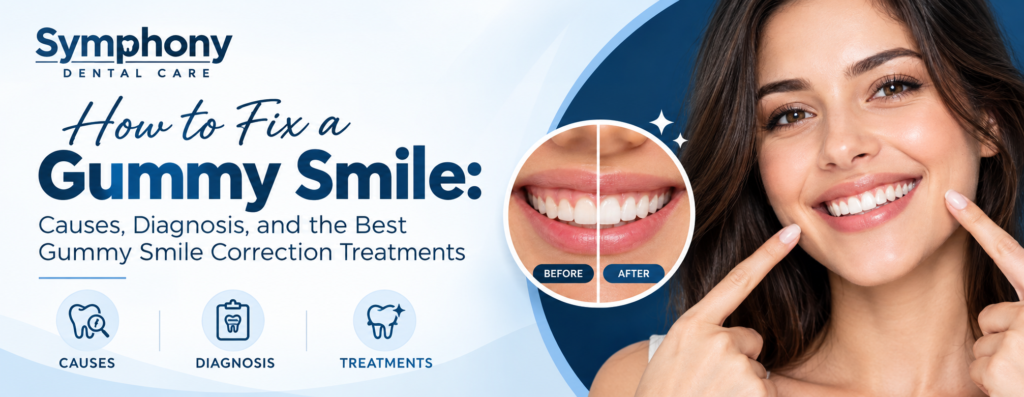
How to Fix a Gummy Smile: Causes, Diagnosis and the Best Gummy Smile Correction Treatments

Reviewed by Dr. Sailee Kalyankar
Last updated: September 5, 2026
Table of Contents
If you find yourself covering your mouth when you laugh, or avoiding photos where your gums show more than your teeth, you’re not alone. A gummy smile (where an excess of gum tissue is visible above the upper teeth when smiling) is one of the most common cosmetic concerns patients bring up in a dental consultation. It’s rarely a health risk, but it can quietly chip away at your confidence.
The good news: gummy smile correction is one of the most predictable, well-studied areas of cosmetic and restorative dentistry today. In this guide, we’ll walk through what actually causes a gummy smile, how dentists diagnose it, and which gummy smile treatment options are best suited to different cases, and explain the way we’d explain it to a patient sitting in our chair.
What Is a Gummy Smile?
Clinically referred to as excessive gingival display, a gummy smile is generally diagnosed when more than 3-4 mm of gum tissue is visible above the upper front teeth during a full smile. Anything less is usually considered within the normal, attractive range.
It’s important to understand that a gummy smile isn’t a disease, it’s a proportion issue. Your teeth, gums, lips, and jawbone all work together to frame your smile, and when one of these elements is slightly out of balance, the gums can dominate the picture more than they should.
What Causes a Gummy Smile?
There isn’t one single cause of a gummy smile. In our experience, it’s usually a combination of two or three factors. Here are the most common ones we see in practice.
1. Excess Gum Tissue (Altered Passive Eruption)
Sometimes the gum tissue simply hasn’t receded fully off the tooth crown as it should during development. The teeth themselves may be a completely normal size, but extra gum tissue covers part of the crown, making teeth look short and gums look prominent.
2. A Hyperactive Upper Lip
This is one of the most frequent causes. If the muscles that lift your upper lip (levator labii superioris) are simply more active or elastic than average, your lip rises higher than usual when you smile, exposing more gum tissue, even if your gums and teeth are perfectly proportioned.
3. Short Clinical Crowns
When the visible part of the tooth the “clinical crown” is naturally shorter than average, teeth can look small in comparison to the gums surrounding them, creating a gummy appearance.
4. Vertical Maxillary Excess
This refers to the upper jawbone growing slightly longer than average in a vertical direction. It’s a skeletal cause, and it’s the reason some gummy smiles need an orthodontic or surgical approach rather than a purely cosmetic one.
5. Worn-Down or Small Teeth
Over time, teeth can wear down due to grinding (bruxism), acid erosion, or aging. As the visible tooth surface shortens, the gum-to-tooth ratio shifts, making the smile appear gummier than it used to.
6. Certain Medications
Some medications, particularly certain blood pressure drugs (calcium channel blockers), anti-seizure medications, and immunosuppressants, can cause gum overgrowth (gingival hyperplasia), which contributes to a gummy appearance.
7. Improper Bite or Tooth Eruption Patterns
Malocclusion (a misaligned bite) can sometimes cause the upper front teeth to erupt at an angle that exposes more gum tissue than normal.
Is a Gummy Smile a Dental Problem or Cosmetic?
This is one of the most common questions patients ask us, and it’s a fair one. In most cases, a gummy smile is purely an aesthetic concern with no impact on oral health. However, there are situations where it does warrant clinical attention:
- Excess gum tissue can trap plaque more easily, slightly increasing the risk of gum inflammation and cavities near the gumline.
- If caused by gum overgrowth from medication, it should always be evaluated to rule out an underlying gum disease process.
- If linked to a bite problem, correcting it can also improve chewing function and long-term jaw comfort.
So while you may be booking a consultation purely for cosmetic reasons, a thorough evaluation is still the right first step.
How Is a Gummy Smile Diagnosed? A Step-by-Step Look
Every credible gummy smile treatment plan starts with an accurate diagnosis, because the fix depends entirely on the cause. Here’s what that process typically looks like at a dental consultation:
- Smile Analysis – The dentist observes your natural, relaxed smile and full smile, measuring how many millimeters of gum are visible.
- Lip Mobility Assessment – Checking how high and how fast your upper lip moves, since a hyperactive lip is one of the leading causes.
- Tooth Proportion Check – Measuring the width-to-height ratio of your front teeth to see if they are naturally short or simply covered by extra gum tissue.
- Periodontal Probing – Gently measuring gum pocket depth to see how much of the tooth crown is hidden under gum tissue versus how much is genuinely covered by bone.
- X-ray or 3D Imaging – Assessing jawbone position and confirming whether the upper jaw itself is contributing to the excess gum display.
- Bite Evaluation – Checking for any misalignment that may be part of the underlying cause.
This full workup usually takes one consultation visit and gives your dentist a clear picture of whether the fix is a simple gum contouring procedure or something that involves orthodontics or oral surgery.
Best Gummy Smile Correction Treatments
Once the cause is identified, treatment is matched to it. Here are the primary options used in modern cosmetic and periodontal dentistry.
1. Laser Gum Contouring (Gum Reshaping)
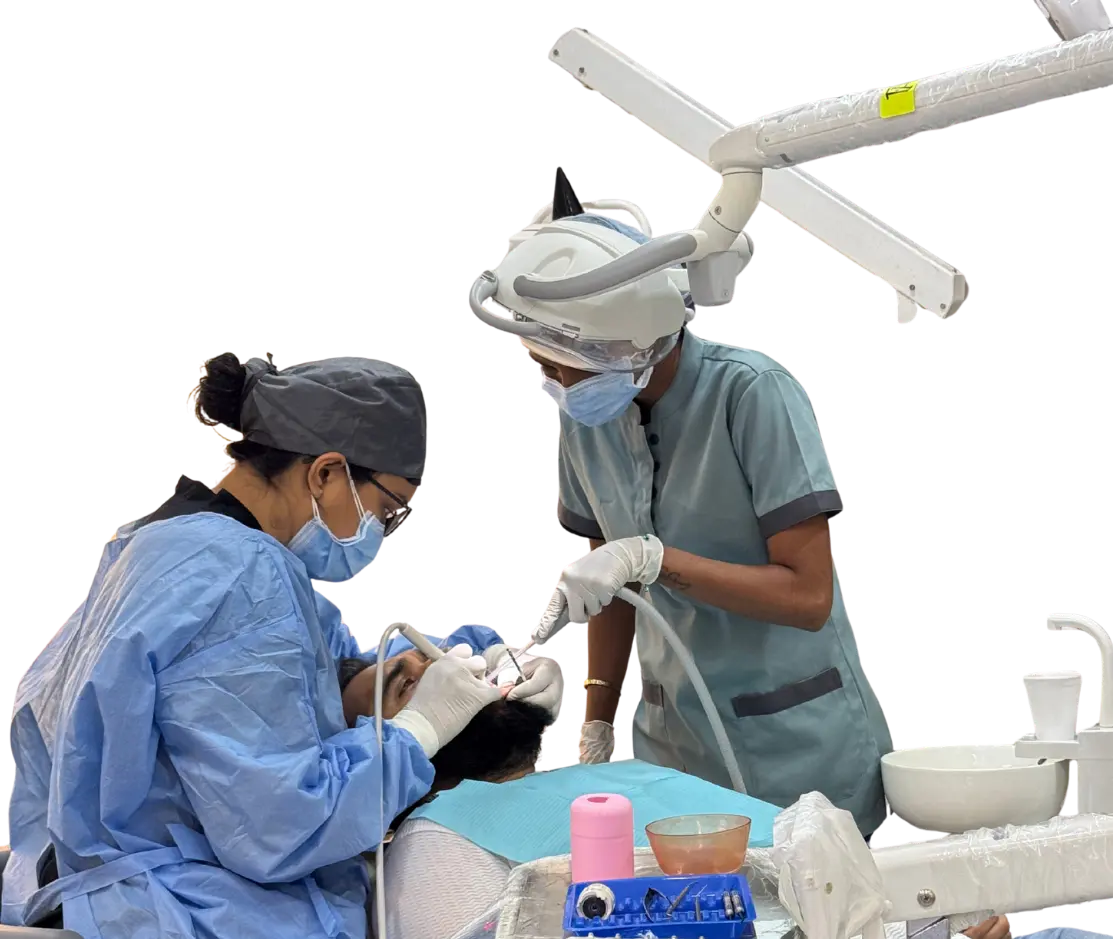
This is the most common and minimally invasive gummy smile correction, ideal when the cause is excess gum tissue covering otherwise normal-sized teeth. A dental laser is used to precisely reshape the gumline, exposing more of the natural tooth crown in a single, virtually bloodless session.
- Typically completed in 30-60 minutes
- Local anesthesia only
- Minimal downtime: most patients return to normal activities the same day
- Results are visible almost immediately, with full healing in about 1-2 weeks
2. Crown Lengthening
A more comprehensive version of gum contouring, crown lengthening may involve removing a small amount of bone in addition to gum tissue. This is used when the tooth crown is significantly covered and needs more of the underlying structure exposed. It’s often done before placing veneers or crowns as well.
3. Lip Repositioning Surgery
For cases where a hyperactive upper lip is the main cause, lip repositioning surgery restricts how high the lip muscles can pull when smiling. A small section of tissue is removed from inside the upper lip, effectively limiting its upward movement. It’s a well-established, predictable procedure for moderate-to-severe gummy smiles caused by lip mobility.
4. Botox for Gummy Smile
A non-surgical, temporary option: a small amount of Botox is injected into the muscles that lift the upper lip, reducing how far it rises during a smile. It’s a great option for patients who want a quick, reversible test before committing to a permanent solution, but results typically last only 3-6 months.
5. Orthodontic Treatment (Braces or Invisalign)
If the gummy appearance is related to how the teeth have erupted or a mild bite misalignment, braces or clear aligners like Invisalign can shift the teeth into a position that naturally reduces gum visibility.
6. Veneers or Cosmetic Dental Treatment
Veneers are not a direct treatment for every gummy smile. However, if tooth size, shape, colour, or proportions also contribute to an imbalanced smile, cosmetic dental treatment may be considered after the gum and bite issues have been evaluated.
The priority should always be preserving healthy tooth structure and selecting treatment based on actual dental needs—not simply making the teeth look larger.
Step-by-Step: What Happens During a Gum Contouring Procedure
Since laser gum contouring is the most frequently recommended gummy smile treatment, here’s a simple walkthrough of what to expect:
- Consultation and digital smile mapping to determine exactly how much gum tissue will be reshaped.
- Local anesthesia is applied so the area is completely numb.
- Laser reshaping of the gumline, tooth by tooth, following the planned smile design.
- Immediate rinse and check to confirm symmetry and proportion.
- Aftercare instructions are given, including a soft-food diet for a day or two and gentle brushing near the treated area.
- Follow-up visit within 1-2 weeks to check healing and final results.
Most patients describe the procedure as far more comfortable than they expected, largely because lasers cauterize as they cut, minimizing bleeding and discomfort.
Did You Know? The chances of successfully saving a knocked-out permanent tooth are generally highest when treatment begins within the first hour after the injury.
Which Gummy Smile Treatment Is Right for You?
Cause | Recommended Treatment |
Excess gum tissue over normal teeth | Laser gum contouring |
Tooth crown needs more exposure (for veneers/crowns) | Crown lengthening |
Overactive upper lip | Lip repositioning or Botox |
Mild bite or eruption issue | Braces / Invisalign |
Upper jaw overgrowth | Orthognathic surgery |
Gum overgrowth from medication | Medical review plus gum contouring |
In many real cases we’ve managed in the clinic, patients actually have a combination cause, for example, mildly excess gum tissue paired with a slightly hyperactive lip. In such cases, a smaller gum contouring procedure combined with Botox often gives excellent results without needing surgery at all.
Recovery and Aftercare After Gummy Smile Correction
- Mild soreness or sensitivity for 2-4 days is normal
- Avoid spicy, hard, or very hot foods for the first 48 hours
- Use a soft-bristled toothbrush around the treated area for the first week
- Avoid vigorous rinsing or spitting the day of the procedure
- Follow-up visits help confirm the gumline is healing symmetrically
Full aesthetic results are usually visible within two to three weeks, once minor swelling settles and the gum tissue matures into its new contour.
A Real-World Example From Practice
A patient in their late twenties came in specifically wanting veneers, convinced that was the only fix for her smile. On evaluation, however, it became clear her teeth were actually a healthy, normal size, simply covered by excess gum tissue from delayed passive eruption. Instead of veneers, a single session of laser gum contouring exposed her natural tooth crowns fully. The result: a balanced, proportionate smile using her own teeth, at a fraction of the cost and treatment time of a full veneer makeover. This is a good reminder that the most invasive-sounding option isn’t always the necessary one; an accurate diagnosis matters more than the treatment name.
Gummy Smile Correction at Symphony Dental Care
If you are considering gummy smile correction in Bandra West, a detailed consultation can help determine whether the concern is related to the gums, teeth, lips, bite, or facial structure.
At Symphony Dental Care, treatment planning focuses on creating a balanced and natural-looking smile rather than simply reducing gum visibility.
Depending on the individual case, your dentist may discuss options such as periodontal reshaping, orthodontic treatment, cosmetic dentistry, or referral for specialist evaluation when required.
If you are looking for a Dentist in Bandra West or a Dentist in Khar West for a gummy smile evaluation, choosing a clinic that focuses on diagnosis before treatment can make a significant difference.
For patients searching for a Dental clinic in Bandra West or a Dental clinic in Khar West, the right treatment should always be personalised to the patient’s facial proportions, dental health, and long-term oral health.
Timelines are approximate and vary based on individual treatment plans and clinical needs.
Expert Insights
According to Dr. Sailee Kalyankar, Cosmetic & Restorative Dentist at Symphony Dental Care, Bandra West, A great smile makeover is not about copying a celebrity’s teeth. It’s about creating a healthy, balanced smile that complements your facial features. Depending on the patient, treatments such as whitening, aligners, bonding, veneers, or crowns may be combined for natural-looking results

Dr. Sailee Kalyankar
BDS, MDS | Conservative Dentist and Microscopic Endodontist. Khar West | Bandra West.
Registration Number A- 35825
Frequently Asked Questions (FAQs)
Most procedures, especially laser gum contouring, are performed under local anesthesia and are far less uncomfortable than patients expect. Mild soreness for a few days afterward is normal and manageable with over-the-counter pain relief.
Surgical options like gum contouring, crown lengthening, and lip repositioning are considered permanent. Botox for a gummy smile is temporary and typically needs to be repeated every 3-6 months.
Yes, in select cases. Botox injections and, in some situations, orthodontic treatment can address a gummy smile without any surgical procedure. Which option works depends on the underlying cause identified during diagnosis.
Costs vary based on the treatments combined. Composite bonding is the most affordable option per tooth, porcelain veneers cost more but last significantly longer, and a full smile makeover combining whitening, veneers, and/or Invisalign will depend on how many teeth are treated.
A single-visit treatment like whitening or bonding can be done in one appointment. A full veneer-based smile makeover with Digital Smile Design typically takes 2–4 weeks across 2–3 visits.
No. A well-planned gum contouring procedure only removes tissue that was covering your natural tooth crown. Digital smile mapping before the procedure ensures the final proportions look natural, not over-corrected.
Most smile makeover procedures involve little to no discomfort. Veneer preparation and bonding are typically done under local anaesthesia if needed, and whitening causes only mild, temporary sensitivity in some patients.
Conclusion
A gummy smile has several possible causes, from excess gum tissue and short tooth crowns to lip mobility and jawbone position, and the right correction depends entirely on which one applies to you. The encouraging part is that most cases can be treated conservatively, with procedures like laser gum contouring offering fast, comfortable, and long-lasting results. A proper clinical evaluation is always the first and most important step, since it determines whether you need a simple in-chair procedure or a more comprehensive treatment plan.
If you’ve been self-conscious about a gummy smile and want an honest assessment of what’s actually causing it, Symphony Dental Care in Bandra West offers personalized gummy smile evaluations and treatment planning under Dr. Sailee Kalyankar. Book a consultation to find out which correction option is the right fit for your smile.
Thinking About Root Canal or Extraction?