

Tooth Extraction vs Root Canal: Which Is Best for a Damaged Tooth?

Reviewed by Dr. Sailee Kalyankar
Last updated: August 14, 2026
Table of Contents
Tooth Extraction vs Root Canal:
A damaged tooth can leave you with a difficult decision: Should you save the tooth with a root canal, or remove it with an extraction? If you have severe tooth pain, deep decay, a cracked tooth, or an infection, it is natural to want the quickest solution. However, removing a tooth is not always the best option because it may appear easier or less expensive initially.
In modern dentistry, the general goal is to preserve your natural tooth whenever it can be restored predictably and safely. Root canal treatment can often remove infection while keeping the natural tooth in place. Extraction, on the other hand, becomes necessary when the tooth is too damaged or compromised to restore.
At Symphony Dental Care, the decision between root canal vs tooth extraction is made after examining the tooth, its roots, surrounding bone, gums, and overall prognosis—not simply based on the level of pain.
If you are searching for an experienced Dentist in Bandra West or Dentist in Khar West, understanding the difference between these two treatments can help you make a more informed decision.
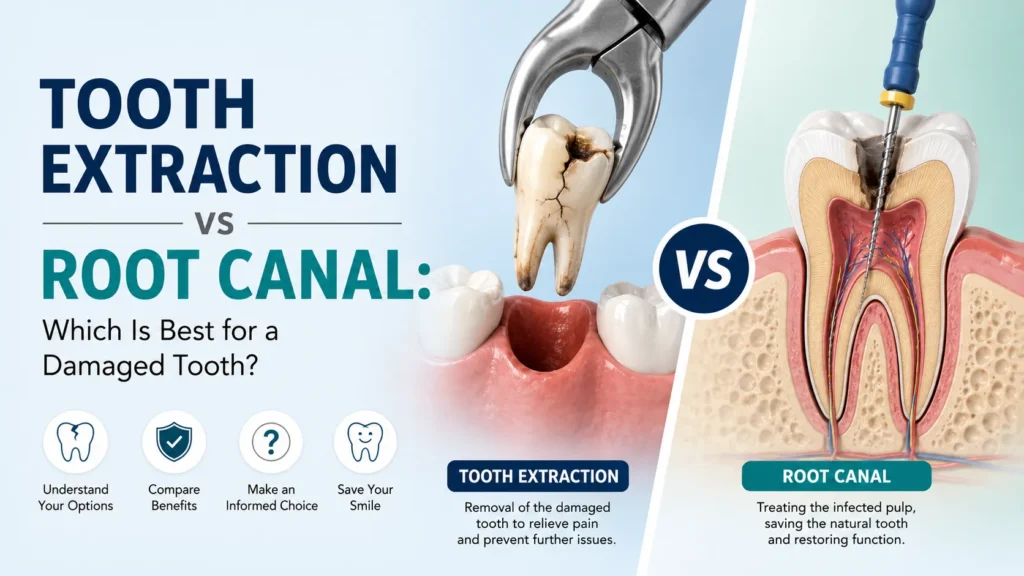
What Is Root Canal Treatment?
A root canal is a tooth-saving procedure used when the soft tissue inside the tooth, known as the pulp, becomes infected or inflamed.
During treatment, the dentist removes the infected pulp, cleans and disinfects the root canals, fills and seals them, and then restores the tooth. Depending on the amount of remaining tooth structure, a dental crown may be recommended to protect it from further fracture.
The important point is that the natural tooth remains in your mouth.
Root canal treatment is commonly recommended for teeth affected by:
- Deep tooth decay
- Pulp infection
- Dental abscess
- Repeated dental procedures
- Certain types of cracks or trauma
- Persistent sensitivity or toothache
What Is Tooth Extraction?
Tooth extraction involves removing a tooth from its socket when it cannot be predictably saved or when removal is necessary for another clinical reason.
Extraction may be considered when a tooth has:
- Extensive decay below the gumline
- A severe fracture that makes restoration impossible
- Significant bone loss due to periodontal disease
- An infection that cannot be managed by other treatment
- A poor long-term prognosis
- Certain wisdom-tooth-related problems
Removing a severely damaged tooth can eliminate the immediate source of infection or discomfort. However, the space left behind may eventually need to be replaced with an implant, bridge, or another prosthetic solution.
This is an important consideration when comparing extraction with root canal treatment.
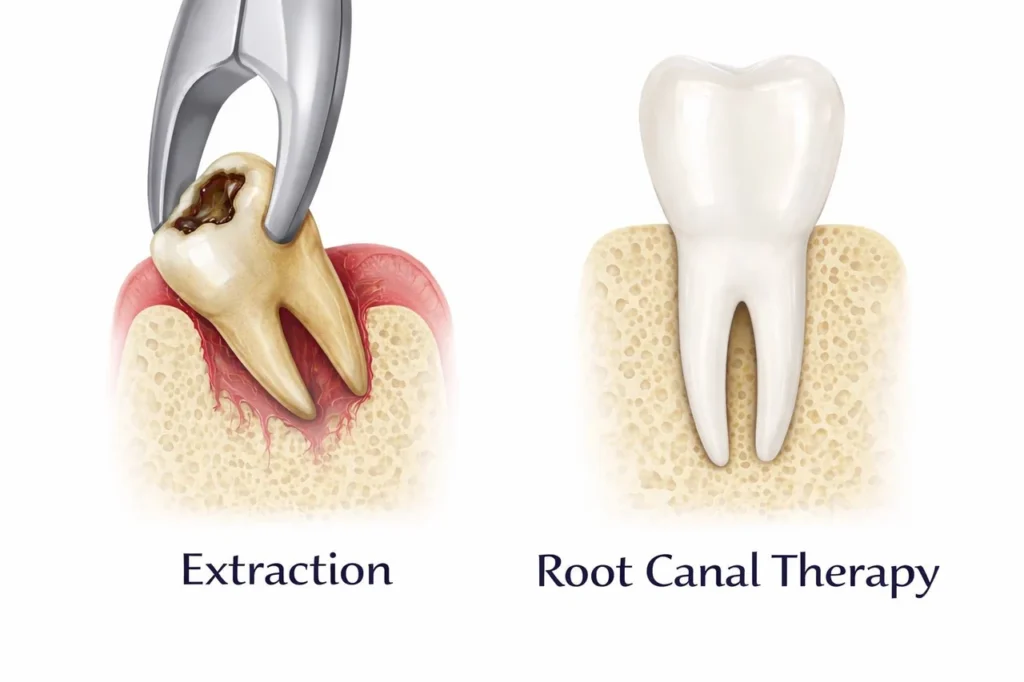
Root Canal vs Extraction: Which Is Better?
If the natural tooth can be predictably restored, root canal treatment is generally preferred because it preserves your natural tooth.
If the tooth cannot be restored or has a very poor prognosis, extraction may be the safer and more appropriate option.
Your dentist needs to assess the tooth before making this decision.
| Factor | Root Canal | Tooth Extraction |
|---|---|---|
| Natural tooth preserved | Yes | No |
| Removes infected pulp | Yes | Tooth is removed |
| Usually requires restoration | Often a crown/filling | Replacement may be needed |
| Treatment objective | Save the tooth | Remove the damaged tooth |
| Jawbone preservation | Helps retain natural tooth function | Bone loss may occur over time |
| Future replacement | Usually not required | Implant/bridge/denture may be considered |
When Is Root Canal Treatment the Better Option?
Root canal treatment is often preferred when the tooth has enough healthy structure to support a long-term restoration. For example, if you have deep decay that has reached the pulp but the tooth can still be structurally restored, removing the infection and restoring the tooth may be preferable to extraction.
Typical symptoms that may indicate the need for root canal evaluation include:
- Persistent toothache
- Pain when biting or chewing
- Prolonged sensitivity to hot or cold
- Swelling around the tooth
- A recurring gum boil
- Darkening of a tooth
- Deep decay or previous trauma
Importantly, symptoms alone cannot determine whether you need a root canal. Dental examination and appropriate imaging are needed to assess the underlying condition.
When Is Tooth Extraction Necessary?
Sometimes saving a tooth simply isn’t realistic. Extraction may be recommended if the tooth is severely fractured, has insufficient remaining structure for a predictable restoration, or has advanced periodontal destruction.
For example, a vertical root fracture can make a tooth unsuitable for conventional root canal treatment and restoration. In such cases, extraction can prevent repeated treatment attempts and allow the dentist to plan an appropriate replacement.
The objective isn’t simply to “save every tooth.” The objective is to choose the treatment that provides the best long-term outcome for the patient.
Is Root Canal More Painful Than Extraction?
This is one of the most common concerns patients have. Modern root canal treatment and tooth extraction are generally performed using local anesthesia, so you should not expect significant pain during the procedure.
After treatment, some tenderness or soreness can occur. The type and duration of discomfort depend on the individual case and the procedure performed. In many situations, patients seek root canal treatment because the infected tooth is already causing significant pain. Treating the underlying infection can help resolve that source of discomfort.
If you are experiencing severe dental pain, don’t wait for it to become unbearable. Visit a Dental clinic in Bandra West or Dental clinic in Khar West for an evaluation.
Did You Know? The chances of successfully saving a knocked-out permanent tooth are generally highest when treatment begins within the first hour after the injury.
Is Extraction Cheaper Than Root Canal?
The initial extraction procedure may cost less than a root canal and crown. However, comparing only the upfront price can be misleading. If an extracted tooth needs to be replaced, the overall treatment may eventually involve:
Extraction → healing → implant/bridge → crown
By contrast, a restorable tooth may require: Root canal → restoration/crown
Therefore, the long-term cost depends on the condition of the tooth and whether replacement is required. A detailed treatment estimate from your dentist is the best way to understand the actual cost in your individual case.
Timelines are approximate and vary based on individual treatment plans and clinical needs.
What Happens After Tooth Extraction?
After an extraction, your body naturally begins healing the socket. Depending on the location and reason for extraction, dentist may discuss replacing the missing tooth with:
- Dental implant
- Dental bridge
- Partial denture
Replacing a missing tooth isn’t always immediate. Your dentist will consider healing, bone condition, gum health, and the planned replacement before deciding the appropriate timing. If you are considering an implant after extraction, discussing the plan before the tooth is removed can be particularly useful.
According to The American Association of Endodontists emphasizes preserving natural teeth whenever possible and recognizes root canal treatment as an established way to save teeth affected by pulpal or periapical disease.
Reference:
https://www.aacd.com/
Can a Cracked Tooth Be Saved With a Root Canal?
It depends on where and how the tooth is cracked. Some teeth with cracks affecting the pulp can potentially be treated with root canal therapy followed by appropriate restoration.
However, a crack extending vertically through the root may make the tooth unsuitable for predictable restoration.
This is why simply assuming that every painful cracked tooth needs either a root canal or extraction can be misleading. A detailed clinical examination is essential.
How Does the Dentist Decide Between Root Canal and Extraction?
Your dentist will typically consider several factors before recommending treatment:
1. Amount of Healthy Tooth Structure
A tooth needs sufficient remaining structure to support a restoration.
2. Extent of Infection
The dentist evaluates whether the infection can be effectively treated and controlled.
3. Root Condition
Root fractures, unusual anatomy, or severe damage can affect the prognosis.
4. Gum and Bone Health
Periodontal support plays an important role in determining whether a tooth can remain functional.
5. Ability to Restore the Tooth
Even if the root canal can technically be performed, the tooth must still be restorable afterward.
6. Long-Term Prognosis
The key question is not simply, “Can we perform a root canal?”
It is:
“Can this tooth be restored and maintained successfully for the long term?”
This approach allows your dentist to recommend treatment based on clinical evidence rather than simply choosing the quickest procedure.
Expert Insights
According to Dr. Sailee Kalyankar, Cosmetic & Restorative Dentist at Symphony Dental Care, Bandra West, a repeatedly failing filling should prompt a closer examination of the tooth rather than an automatic decision to place another filling.

Dr. Sailee Kalyankar
BDS, MDS | Conservative Dentist and Microscopic Endodontist. Khar West | Bandra West.
Registration Number A- 35825
Why Patients Choose Symphony Dental Care
At Symphony Dental Care, the focus is on preserving natural teeth whenever clinically possible while ensuring that treatment decisions are based on the patient’s individual condition.
A detailed examination helps determine whether root canal treatment, extraction, or another restorative option is appropriate.
The team combines modern diagnostic technology with personalized treatment planning to help patients understand their options before proceeding. Whether you need emergency care for severe tooth pain or are considering treatment for a badly damaged tooth, consulting an experienced Dentist in Bandra West or Dentist in Khar West can help you make an informed decision.
Symphony Dental Care provides comprehensive dental care for patients looking for a reliable Dental clinic in Bandra West or Dental clinic in Khar West.
Frequently Asked Questions (FAQs)
If a tooth can be predictably restored, root canal treatment is generally preferred because it preserves the natural tooth. Extraction may be necessary when the tooth cannot be restored or has a poor prognosis.
Whenever clinically possible, preserving a natural tooth is generally preferred. However, extraction may provide a better long-term outcome when a tooth is severely damaged or unrestorable.
Both procedures are typically performed under local anesthesia. Some soreness may occur afterward, but the level of discomfort varies from person to person and depends on the condition of the tooth.
A dentist needs to examine the tooth and may use dental X-rays or other imaging to determine whether it is restorable. Symptoms alone cannot reliably determine which treatment is needed.
Extraction may have a lower initial cost, but replacing the extracted tooth with an implant, bridge, or denture adds to the overall expense. A root canal may require a crown or other restoration.
Sometimes. If enough healthy tooth structure remains to support a restoration, root canal treatment may save the tooth. If the tooth cannot be restored predictably, extraction may be recommended.
Some cracked teeth can be treated with root canal therapy and a protective restoration. However, teeth with certain types of root fractures may not be suitable for saving.
An untreated infected or severely damaged tooth may develop worsening pain, an abscess, swelling, or bone damage. Dental infections can sometimes become serious and require urgent treatment.
A crown is often recommended for teeth that have lost significant structure, particularly premolars and molars. The appropriate restoration depends on how much healthy tooth remains and the tooth’s location.
Yes. Dental implants are one option for replacing extracted teeth. The timing depends on factors such as healing, bone volume, gum health, and the specific treatment plan.
Conclusion
When it comes to tooth extraction vs root canal, the right treatment depends on whether the damaged tooth can be predictably restored.
If the tooth can be saved, root canal treatment allows you to retain your natural tooth and avoid the need for replacement. If the tooth is severely damaged or has an unfavorable prognosis, extraction may be the more appropriate choice.
The best decision isn’t necessarily the cheapest or fastest treatment. It is the treatment that gives you the best chance of maintaining a healthy, functional mouth in the long term.
If you have severe tooth pain, swelling, deep decay, or a broken tooth, don’t wait for the problem to worsen. Get the tooth evaluated by a qualified dental professional.
Thinking About Root Canal or Extraction?