

Severe Toothache? What to Expect During Root Canal Treatment in Bandra West

Reviewed by Dr. Sailee Kalyankar
Last updated: June 24, 2026
Table of Contents
Quick Treatment Guide for Root Canal Treatment
Q: Is Root Canal Treatment in Bandra West Mumbai painful?
A: No. With topical numbing gel, slow anaesthesia delivery, and dental microscope precision, modern root canals at Symphony Dental Care feel like pressure — not pain. Most patients are surprised at how comfortable it is.
Q: Can root canal treatment be done in a single sitting?
A: Yes, in most cases. Single-sitting root canals are possible for straightforward infections. Complex or multi-rooted cases may require 2 sittings, which Dr. Sailee Kalyankar will confirm at consultation.
Q: Is saving a tooth with RCT better than extraction?
A: Yes. Nothing functions like your natural tooth. Extraction leads to bone loss, shifting of adjacent teeth, and the need for implants or bridges — all more expensive and complex than RCT.
Q: Is a dental crown mandatory after root canal treatment?
A: For back teeth, yes — a crown is strongly recommended to prevent fracture. For front teeth, a crown may not always be required. Your dentist will guide you based on which tooth was treated.
Q: How does a dental microscope improve root canal outcomes?
A: A dental microscope magnifies the canal up to 25x, revealing missed canals, micro-fractures, and secondary infections invisible to the naked eye — directly reducing retreatment rates and improving long-term success.
Root Canal Treatment in Bandra West Mumbai is, without question, the most feared dental procedure in existence — and also the most misunderstood one. The fear is real, the reputation is widespread, and most of it is built on stories from a decade or two ago, not on what actually happens in a modern dental clinic today.
Here is the truth: the pain people associate with a root canal is the pain of the infection before the procedure — not the procedure itself. A root canal does not cause pain. It ends it.
If you are sitting with a throbbing toothache right now, or a dentist has told you that you need a root canal and you have been quietly avoiding the appointment — this guide is for you. We will explain exactly what happens, why modern treatment feels nothing like the reputation suggests, and why choosing to save your tooth today is one of the smartest decisions you can make for your long-term health.
How Does Modern Technology Make Root Canal Treatment in Bandra West Mumbai Completely Painless?
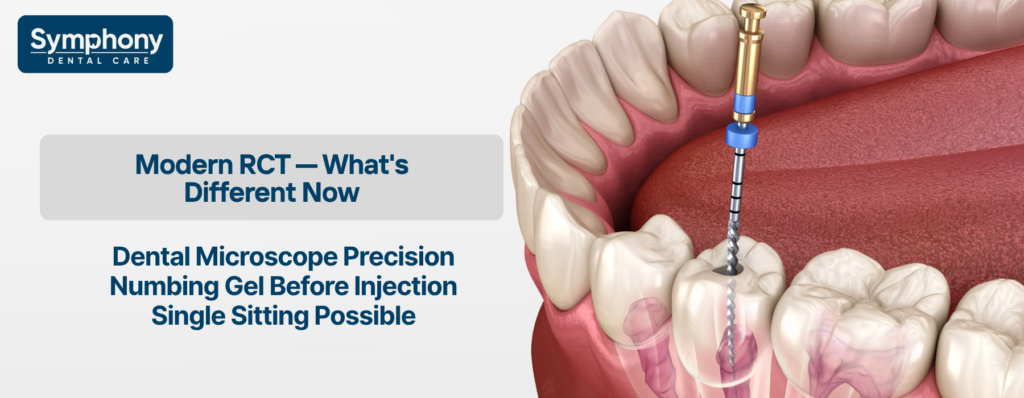
Modern Root Canal Treatment in Bandra West Mumbai is painless because of three specific advances — topical numbing gel that eliminates injection discomfort, slow anaesthesia delivery that produces pressure instead of pain, and dental microscope precision that makes the procedure faster, more accurate, and less physically demanding on the tooth.
Most people’s fear of root canals is anchored in one moment: the injection. What they do not know is that this moment has been almost entirely transformed by modern technique.
Before any needle approaches your mouth at Symphony Dental Care, a topical numbing gel is applied to the gum surface and given several minutes to work fully — not a perfunctory thirty seconds. By the time the anaesthetic injection is administered, the surface is already numbed. The injection itself is delivered slowly, at body temperature, producing a mild sensation of pressure rather than the sharp sting most people expect.
From this point, the tooth and surrounding area are completely numb. You feel nothing during the actual procedure — not drilling, not cleaning, not any of it.
Root Canal Treatment in Bandra West Mumbai using dental microscope painless technology
The Dental Microscope — The Single Biggest Game Changer
This is what separates a root canal at Symphony Dental Care from a standard clinic. Dr. Sailee Kalyankar is a trained microscopic endodontist — meaning she performs every root canal under a high-powered dental microscope that magnifies the working area up to 25 times.
Why does this matter for your comfort and outcome?
Under standard magnification, the human eye simply cannot see everything inside a root canal system. Teeth — particularly back molars — often have additional canals that do not appear on X-rays and are missed during conventional treatment. Missed canals mean residual bacteria remain, causing the infection to return months or years later, requiring retreatment.
Under a dental microscope, every canal is identified and treated. Every micro-fracture is spotted. Every last trace of infected tissue is removed with precision impossible without magnification. The result is a root canal that is done properly the first time — with a significantly higher long-term success rate and a dramatically lower chance of retreatment.
Single-Sitting Root Canals — Real or Marketing?
For most straightforward cases, yes — a single-sitting root canal is genuinely possible and clinically appropriate. The entire procedure — numbing, access, cleaning, shaping, and sealing — can be completed in one appointment, typically lasting 60 to 90 minutes.
For more complex cases — severely curved canals, multi-rooted teeth with significant infection, or cases requiring active medication between visits — two sittings may be clinically necessary. Dr. Sailee Kalyankar will tell you honestly at your first appointment which applies to your specific case, rather than marketing a “single-sitting guarantee” that overrides clinical judgment.
Why Is Saving Your Natural Tooth With RCT Better Than a Complete Extraction?
Saving your natural tooth with root canal treatment is almost always the better clinical and financial decision — because nothing manufactured by science functions, feels, or lasts as well as your own tooth.
This is not a dental clinic selling a procedure. This is a clinical fact that the dental profession universally agrees upon.
![Root Canal Treatment in Bandra West Mumbai saving natural tooth better than extraction]
When a tooth is extracted, several things happen that most patients are not told about upfront:
Bone loss begins immediately. Your jawbone requires the stimulation of tooth roots to maintain its density. When a tooth is removed, the bone in that area begins to resorb — gradually shrinking over months and years. This bone loss affects the shape of your face over time and complicates future implant placement.
Adjacent teeth begin to shift. The teeth on either side of the gap slowly drift into the empty space. The tooth directly above or below the gap may begin to over-erupt — moving toward the space where it once had a biting partner. This progressive misalignment creates bite problems that extend well beyond the original extraction site.
Replacement options are expensive and complex. A dental implant — the gold standard for replacing a missing tooth — costs significantly more than a root canal and crown combined. A bridge requires grinding down two healthy adjacent teeth to support a false tooth between them. Dentures, while affordable, are removable and do not stimulate bone.
The calculus is straightforward: Root Canal Treatment in Bandra West Mumbai preserves the tooth you were born with, maintains your bone, keeps your bite stable, and costs less than the replacement options that become necessary after extraction.
The only exception is a tooth that is genuinely unsalvageable — severely fractured below the gum line, or lost so much bone support that no treatment can maintain it long-term. In these cases, Dr. Sailee Kalyankar will tell you clearly that extraction is the right call, and discuss replacement options with full transparency. A conservative dentist recommends what is actually necessary — not what adds more treatment to your plan.
Experienced a dental emergency that led to this diagnosis? Read Dental Emergency in Bandra? 5 Signs You Need an Emergency Dentist in Bandra West Right Now to understand how acute infections are handled before planned treatment begins.
Is Putting a Protective Dental Crown Mandatory Immediately After a Root Canal?
For back teeth — molars and premolars — a dental crown after root canal treatment is strongly recommended, because these teeth bear the highest biting forces and are at significant risk of fracture without crown protection. For front teeth, a crown may not always be immediately necessary.
This is one of the most common questions patients ask after their root canal is complete — and it deserves a direct, honest answer rather than a blanket “yes, you need a crown.”
Here is the clinical reality:
Why Back Teeth Need a Crown
A root canal removes the infected pulp from inside the tooth — but it also removes the moisture and vitality that kept the tooth flexible. A treated molar or premolar becomes more brittle than a living tooth. Under the daily forces of chewing — which can exceed 80 kilograms of force on a back molar — an uncrowned, root-canal-treated tooth has a meaningful risk of fracturing. Not cracking. Fracturing in a way that splits the tooth vertically, making it unrestorable and requiring extraction.
A zirconia crown placed over the treated tooth distributes biting force evenly across the tooth’s surface, protecting it for years. This is not an add-on procedure designed to inflate the bill — it is a clinically necessary step that protects the investment of the root canal treatment itself.
What About Front Teeth?
Front teeth — incisors and canines — experience significantly less biting force. In many cases, a tooth-coloured composite restoration sealing the access opening is sufficient to protect a root-canal-treated front tooth, particularly if the tooth structure remaining is largely intact. Dr. Sailee Kalyankar will assess how much tooth structure is present after treatment and recommend the appropriate restoration — crown or composite — based on the clinical picture, not a default recommendation.
Timing — How Soon After the Root Canal?
Ideally, crown placement should occur within a few weeks of completing the root canal. Delaying this step — particularly for back teeth — significantly increases fracture risk during the waiting period. Temporary materials used to seal the access point are exactly that: temporary, not a long-term solution.
Why Symphony Dental Care for Root Canal Treatment in Bandra West Mumbai
Dr. Sailee Kalyankar — BDS, MDS | Conservative Dentist & Microscopic Endodontist
Dr. Sailee Kalyankar is not a general dentist who occasionally performs root canals. She is a post-graduate specialist in conservative dentistry with advanced training specifically in microscopic endodontics — the subspecialty within dentistry dedicated entirely to root canal treatment performed under dental microscope magnification.
This distinction matters enormously. A root canal performed by a general dentist without microscope guidance and a root canal performed by a microscopic endodontist are genuinely different procedures in terms of precision, complication identification, and long-term success rate.
Patients who visit Symphony Dental Care for root canal treatment consistently describe the same experience: they came in expecting the worst and left wondering what all the fear was about. That reaction is not coincidence — it is the result of a clinical approach designed around patient comfort from the moment of numbing to the final seal of the canal.
Dr. Sailee’s conservative philosophy also means she will only recommend a root canal when the clinical evidence genuinely supports it. If a tooth can be saved with a well-placed filling, that is what she will recommend. If retreatment of a previously failed root canal is possible, she will explore that before considering extraction. The patient’s best interest guides every recommendation.
What Every Root Canal Patient at Symphony Dental Care Receives
- Topical numbing gel before any injection — every time, no exceptions
- Dental microscope for all root canal procedures — precision that standard clinics cannot offer
- Digital X-rays — immediate, low-radiation imaging to assess canal anatomy before and during treatment
- Thorough canal cleaning and shaping — using modern rotary instruments for efficiency and precision
- Biocompatible sealing materials — canals sealed with materials that are safe, inert, and long-lasting
- Clear post-treatment guidance — what to expect, what to avoid, and when to return for the crown
Planning your crown placement after the root canal? Read our guide on Best Dentist in Bandra West at Symphony Dental Care to understand the full range of restorative options available for tooth protection after RCT.
Price Breakdown: Root Canal Treatment Costs in Bandra West Mumbai
| Treatment | Approx. Cost (INR) | Notes |
|---|---|---|
| Consultation & X-Ray | ₹300 – ₹700 | Includes clinical assessment |
| RCT — Front Tooth (1 canal) | ₹6,000 – ₹9,000 | Single sitting, microscopic |
| RCT — Premolar (2 canals) | ₹8,000 – ₹12,000 | Single/double sitting |
| RCT — Molar (3–4 canals) | ₹10,000 – ₹15,000 | Most complex case |
| Retreatment (failed RCT) | ₹12,000 – ₹18,000 | Microscopic precision essential |
| Zirconia Crown (post-RCT) | ₹8,000 – ₹18,000 | Strongly recommended for molars |
| Temporary Restoration | ₹800 – ₹2,000 | Between sittings if required |
All costs are confirmed in writing at consultation — before any procedure begins. No surprises, no pressure.
Frequently Asked Questions (FAQs)
A root canal removes infected or inflamed tissue from inside the tooth — eliminating the source of pain, stopping the spread of infection, and saving the tooth from extraction.
Persistent throbbing toothache, prolonged sensitivity to hot or cold, swollen gums near a tooth, darkening of a tooth, or a visible abscess are common indicators. A digital X-ray confirms the diagnosis.
Most single-sitting root canals at Symphony Dental Care are completed in 60–90 minutes, depending on the number of canals and case complexity.
No. The area is completely numbed before any instrument is used. You may feel mild pressure — not pain — during the procedure.
Mild soreness for 2–3 days after treatment is normal, managed easily with standard over-the-counter pain relief. Most patients return to full normal activity the next day.
Often yes — even significantly infected teeth can be successfully treated. The extent of infection and remaining tooth structure determine eligibility, which Dr. Sailee assesses at consultation.
In almost all cases, yes. Extraction leads to bone loss, shifting teeth, and expensive replacement options. A root canal preserves your natural tooth for a fraction of the long-term cost.
The infection spreads — to surrounding bone, adjacent teeth, and potentially beyond the jaw. Delayed treatment typically means more complex, more expensive intervention and increased risk of losing the tooth entirely.
Modern root canal treatment has a success rate of 85–97%, with microscopic endodontics achieving outcomes at the higher end of this range due to superior canal identification and cleaning.
The Root Canal Is Not the Enemy — The Infection Is
Every patient who has actually experienced modern root canal treatment says the same thing: “It was nothing like I expected.” The procedure that has terrified generations is, with today’s techniques and technology, one of the most effective and comfortable treatments in dentistry.
If a severe toothache has been keeping you up at night, or a dentist’s recommendation has been sitting in the back of your mind for weeks — the kindest thing you can do for yourself is act on it now. The longer an infection stays, the more complex the treatment needed to resolve it.
Root Canal Treatment in Bandra West Mumbai at Symphony Dental Care, performed by Dr. Sailee Kalyankar under dental microscope precision, is your path from pain to relief — often in a single visit.
Come in. It is far more manageable than you think.
Symphony Dental Care | Bandra West & Khar West, Mumbai Call: 7678045993 Open 7 Days | 7:45 AM – 10:00 PM