
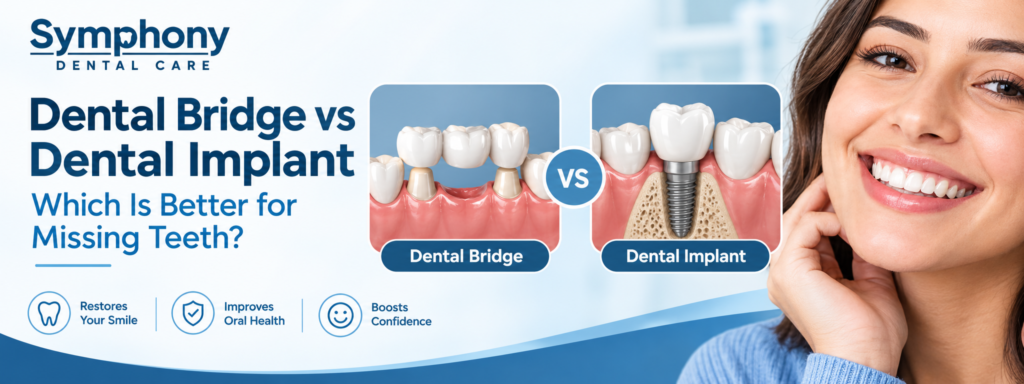
Dental Bridge vs Dental Implant | Which Is Better for Missing Teeth?

Reviewed by Dr. Sailee Kalyankar
Last updated: September 14, 2026
Table of Contents
Losing a tooth, whether from decay, injury, or gum disease, is more common than most people realise, and it almost always brings up the same question: should I get a dental bridge or a dental implant? Both options restore your smile and your ability to chew properly, but they work, cost, and age very differently inside your mouth.
Having guided hundreds of patients through this exact decision over the past several years, I can tell you there’s no single “better” option for everyone. The right choice depends on your bone health, budget, how long you want the restoration to last, and the condition of your neighbouring teeth.
What Is a Dental Bridge?
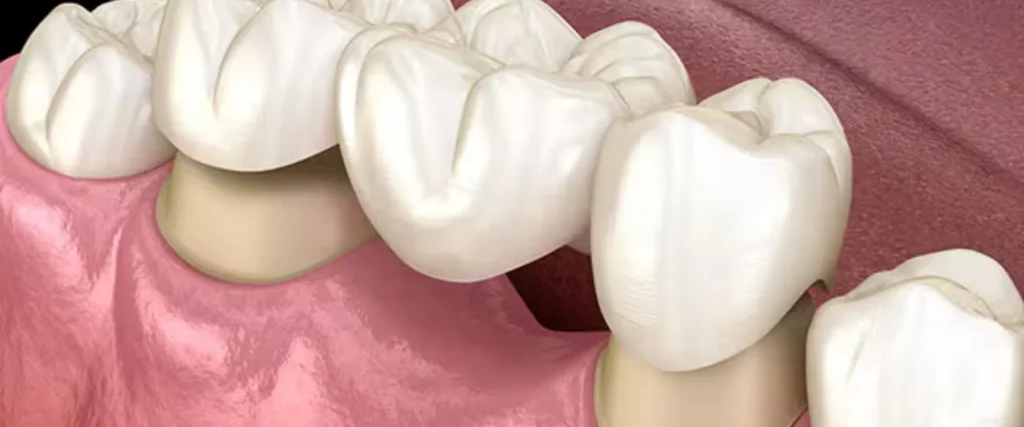
A dental bridge is a fixed restoration that “bridges” the gap left by a missing tooth. It typically consists of:
- One or more artificial teeth (called pontics)
- Two crowns that anchor the bridge to the healthy teeth on either side of the gap
Adjacent teeth are shaved down to hold the crowns, and the entire structure is cemented in place. It doesn’t come out, and it usually takes just two dental visits over a couple of weeks.
What Is a Dental Implant?
A dental implant replaces the missing tooth from the root up. A titanium (or zirconia) post is surgically placed into the jawbone, where it fuses with the bone over a few months in a process called osseointegration. Once healed, a custom crown is attached on top.
Unlike a bridge, an implant doesn’t rely on neighbouring teeth for support. It stands independently, functioning much like a natural tooth root.
Dental Bridge vs Dental Implant: Key Differences
1. Impact on Neighbouring Teeth
This is the biggest clinical difference between the two.
- Bridge: Requires filing down two healthy adjacent teeth to fit the crowns. This is irreversible and can weaken otherwise strong teeth.
- Implant: Doesn’t touch neighbouring teeth at all. It’s a self-contained solution.
If your adjacent teeth are healthy, most dentists, myself included, generally recommend preserving them rather than reshaping them for a bridge.
2. Durability and Lifespan
When patients ask, “Should I get a dental implant or a bridge for the long run?” longevity is usually the deciding factor.
- Dental bridges typically last 10–15 years before they need replacement or repair.
- Dental implants, with good oral hygiene, can last 20–30 years or even a lifetime.
Implants also don’t develop decay (since they’re not natural tooth structure), though the surrounding gum still needs care.
3. Bone Health Preservation
This is something patients rarely think about until it’s explained.
- A missing tooth root means the jawbone in that area gradually shrinks over time; this is natural bone resorption.
- Bridges sit on top of the gum and do nothing to stimulate the bone underneath, so bone loss continues.
- Implants replace the root itself, stimulating the bone just like a natural tooth would, which helps preserve your jaw structure and facial shape.
4. Procedure Time and Recovery
- Bridge: Completed in 2–3 visits over 2–3 weeks. Minimal downtime, mild sensitivity possible after tooth preparation.
- Implant: A longer process: surgical placement, a 3–6 month healing period for osseointegration, then the crown placement. More involved, but the results are far more permanent.
If you need a faster fix (for a wedding, event, or urgent situation), a bridge may suit your timeline better.
5. Cost Comparison
Generally speaking:
- Bridges have a lower upfront cost, making them attractive for immediate budget constraints.
- Implants cost more initially but often work out more economical over a lifetime, since bridges typically need replacement every decade or so, while implants are a one-time investment in most cases.
Your dentist can give you an exact quote based on your case, materials chosen (zirconia vs titanium, porcelain vs metal-fused ceramic), and the number of teeth involved.
6. Appearance and Chewing Function
Both restorations can look very natural today, thanks to advances in ceramics and zirconia materials.
- Bridges blend in well but can occasionally show a shadow at the gumline as the jawbone recedes underneath.
- Implants maintain their appearance and fit consistently over time because the bone doesn’t shrink away from a root that’s actively anchored in it.
For chewing strength, implants generally offer a bite force closer to natural teeth, since they’re rooted directly in bone rather than relying on adjacent teeth for support.
7. Maintenance
- Bridges require special floss threaders or water flossers to clean underneath the pontic, since food debris can get trapped there.
- Implants are cleaned just like natural teeth, brushing and flossing normally, though regular dental check-ups are still essential.
Who Should Consider a Dental Bridge?
A bridge may be the right call if you:
- Have healthy, strong teeth on either side of the gap that could use crowns anyway
- Want a quicker solution without surgery
- Have a lower initial budget
- Aren’t a candidate for implant surgery due to certain medical conditions or insufficient bone density (without bone grafting)
Who Should Consider a Dental Implant?
An implant is usually the stronger long-term choice if you:
- Want to preserve your natural, healthy adjacent teeth
- Are looking for a solution that can last decades
- Have adequate jawbone density (or are open to a bone graft)
- Want to prevent jawbone shrinkage and maintain facial structure
- Are missing a single tooth, several teeth, or even need full-arch replacement
Bridge vs Implant: Quick Comparison Table
Factor | Dental Bridge | Dental Implant |
Affects neighbouring teeth | Yes | No |
Average lifespan | 10–15 years | 20–30+ years |
Treatment time | 2–3 weeks | 3–6 months (with healing) |
Preserves jawbone | No | Yes |
Upfront cost | Lower | Higher |
Long-term value | Moderate | High |
Surgery required | No | Yes |
Timelines are approximate and vary based on individual treatment plans and clinical needs.
Expert Insights
According to Dr. Sailee Kalyankar Zirconia implants offer a metal-free option for selected patients. Proper diagnosis, precise placement, healthy gums, and regular maintenance are key to long-term success

Dr. Sailee Kalyankar
BDS, MDS | Conservative Dentist and Microscopic Endodontist. Khar West | Bandra West.
Registration Number A- 35825
Frequently Asked Questions (FAQs)
For most patients with adequate bone health, implants are considered the superior long-term option since they preserve jawbone and don’t affect neighbouring teeth. However, bridges remain a valid, faster, and more affordable choice in specific cases.
Bridges are cheaper upfront. Implants cost more initially but often prove more cost-effective over 15–20 years since they rarely need replacement.
The procedure is done under local anaesthesia, so discomfort during placement is minimal. Mild soreness for a few days afterward is normal and manageable with standard pain relief.
With good oral hygiene, a bridge typically lasts 10–15 years before needing repair or replacement.
Yes, a bone graft procedure can build up the area first, making you eligible for an implant a few months later.
An implant is often preferred for a single missing tooth since it avoids altering two healthy adjacent teeth just to support a bridge.
Typically 2 visits: one to prepare the adjacent teeth and take impressions, and a second to fit the final bridge, usually 1–2 weeks apart.
Yes. Modern implant crowns are custom-shaded and shaped to match your natural teeth, and they maintain their appearance well over time.
Neighbouring teeth can shift into the gap, your bite can become misaligned, and the jawbone in that area will gradually shrink, affecting your facial structure over time.
Absolutely. Only a clinical exam, including X-rays and a bone density check, can confirm which option truly suits your mouth. If you’re in Mumbai, you can book a consultation at our dental clinic in Khar West for personalised, painless treatment planning.
Conclusion
There’s genuinely no universal winner in the dental implant vs bridge debate. It comes down to your oral health, timeline, and priorities. At Symphony Dental Care, we assess your bone density, gum health, and the condition of neighbouring teeth through a detailed clinical exam and imaging before recommending either option. In many cases, we find that patients who are candidates for implants are happier long-term, simply because they avoid touching healthy teeth and enjoy a more permanent result.
If you’re also exploring metal-free alternatives, you may want to read our detailed guide on Zirconia Dental Implants, a popular option for patients who prefer a tooth-coloured, biocompatible material.
Related Reads
- Zirconia Dental Implants: Metal-Free Option for Missing Teeth
- Best Dental Clinic in Khar West for Painless Treatment
- Symphony Dental Care – Khar West
Thinking About Root Canal or Extraction?